Tuesday, 31 March 2015

Bali Tegalalang Rice Terrace

Bali Tegalalang Rice Terrace located on the north side of Ubud around 20 minutes drive. This area is famous tourist attraction for beautiful rice terraces, many tourists who travel to and from Kintamani stopped at this place to witness the beauty of the verdant terraced rice field scenery or having lunch at the restaurant while enjoying the beautiful scenery of terraced rice fields. Tegalalang Rice Terrace is one of the tourist icon in Ubud Bali.
 
The rice terrace is designed very beautiful with exquisite hollowing rice field and precisely located on the hill bank. In this place, you will see the Balinese farmer do their rice field in oblique area complete with its system irrigation. You will enjoy the beautiful panorama of valley with rice terrace and coconut trees ornament it.
The northern part of Ubud, there is one area called Tegalalang, where many great home industries. Hundreds of miscellaneous crafts of cat and mouse, dolphin, giraffe, etc. that are made of wood or iron were manufactured here.  Other handicrafts produced are bags of different models from a variety of materials, stone carvings, cheap wooden carvings, wooden masks, all sorts of glass handicrafts is formed into a vase, unique bottles or plates. Everything is here. Shop and showroom is lined up along the 10 km, if we’re shopping here, of course depends on how thick is your pocket.  It’s endless.


Best Regards
Kompra Made (Made Sujana)

Sunday, 29 March 2015

The mysterious Goa Gajah (elephant cave)

The mysterious Goa Gajah (elephant cave) is one of the oldest relics on Bali. The exact time of origin is uncertain, but archeologists estimate the cave to have been built around year 1022 AD. This was long before Majapahit entered the island, and also hundreds of years before the first Europeans set foot here. The site is a mix of Hindu- and Buddhist symbols, among them the cave with the entrance in an artistically carved cliff, a bathing pool with fountains, a statue of the Buddhist goddess Hariti, as well as several other Buddha figures.
The cave was only known by the locals until 1923, when a young Dutch found the place after hearing some conversation about a monster head with elephant ears.
The left wing of the cave: three linga, symbols of fertility.It soon became apparent that it was rather a head of a demon, not an elephant, but this misunderstanding probably gave the cave it’s name. Another explanation for the name is that it comes from the statue of the elephant god Ganesh, a third explanation is that Javanese writings from 1365 says that a Buddhist hermit lived near Lwa Gajah, the elephant river. This probably points to the Petanu river close by and probably also to the cave, which is quite similar to hermitages found on East Java. Yet another interpretation of the name is that the cave was created by the legendary giant Kebo Iwo, who also according to the myth built Gunung Kawi and Yeh Pulu. The demon above the cave entrance should then be a portrait of the same Kebo Iwo.
The demon is in fact meant to protect the site, this is quite common on Bali were demonic faces like this is found on temples and other buildings all over the island. Who this particular demon is meant to portrait is still disputed, except for Kebo Iwo it has been suggested that it is the witch Rangda or maybe Shiva Pasiputi. Shiva Pasiputi divided the cosmic mountain Mahameru in two and created the rival mountains Agung and Batur, as well as the characteristic split gate that can be seen everywhere on Bali. The fingertips of the demon seems to push aside a jungle of carved animals, cliffs, leaves, waves and demons.
Three of the statues in the old bathing pools.The cave is manmade and has the shape of a T, it is two meters high and one meter wide. It contain 15 niches which is regarded as proof that this was not a temple. At the end of the left wing there is a one meter tall, four armed statue of the elephant god Ganesh, at the end of the right wing there is three half meter tall “linga”, fertility symbols of the Hindu God Shiva. On the walls there are some old-Javanese writings which has helped to establish the time of origin of the cave.
The bathing place in front of the cave was not discovered before 1954. It then became apparent that the whole complex has been an important religious site in old Bali.
Parts of the statues in the bathing pools were first found close by the cave, and later the bathing pool itself were excavated. The bathing pools are divided in two, one for men and one for women, each part with three water sprouting statues. The statue parts first found fit perfectly to the parts found by the pools. Another bathing place were later found further down the hill, with steps leading down to it. These findings is said to be the most important done on Bali since WW2.
The old bathing pools.To the left of the cave there is a statue of the Buddhist goddess Hariti, a child-eating witch worshipped in India. She converted to Buddhism and transformed into a fertility goddess and a protector of children. On Bali she is also known as Men Brayut, a name often used on poor women with many children. South of the cave there is a small shrine with two Buddha figures, or it used to be two until 2000 when one was stolen. Close by there is some fragments of old relief’s, probably much older than the cave.
Goa Gajah can be difficult to find on your own, from south you drive towards Gianyar, by the “baby monument” after Batuan you continue straight ahead towards Ubud, then turn right at Teges towards Bedulu. The site is on the right side two kilometers before the Bedulu village. You know you’re there when you see the large parking lot and the many souvenir stalls. From Goa Gajah it is possible to take a walk through the rice fields in Bedulu and to Yeh Pulu, it is recommended that you pay one of the local kids to guide you.

Friday, 27 March 2015

Tenun Bali yang Melegenda

Kain Tenun bukan hanya buah keterampilan turun-temurun bagi masyarakat Bali, melainkan juga bentuk identitas kultural dan artefak ritual. Di luar lingkup tradisi masyarakat daerah tujuan wisata, kain tenun Bali pun tidak sebatas cendera mata atau sekedar oleh-oleh khas Bali semata, tetapi terus berkembang sebagai komoditas ke dunia fashion yang berbasiskan budaya.
Seperti halnya masyarakat pengrajin kain tenun Bali yang terkenal yaitu di Desa Sidemen di Kabupaten Karangasem sebagai salah satu pusat produksi kain tenun di Bali. Menenun kain menjadi aktivitas sehari-hari di hampir semua rumah di desa Sidemen ini melakukan kegiatan rutinnya sebagai penenun. Hampir semua orang di desa ini bisa menenun, belajar dari orang tua mereka secara turun temurun.
 Image result for TENUN BALI
Di kelilingi oleh kehijauan alam yang alami mendominasi pemandangan di Sidemen. Keindahan sawah berundak membuat para touris lokal dan mancanegara kerapkali melakukan pelesiran menuju Sidemen, sekitar dua jam perjalanan dari Denpasar.
Di Sidemen sterdapat dua jenis utama kain tenun yang selama ini di pasarkan di Bali dan luar Bali. Kain tenun Ikat, biasa disebut endek, dipakai sehari-hari. Sementara kain tenun songket digunakan untuk beragam upacara penting dalam siklus kehidupan masyarakat Bali, antara lain upacara potong gigi, perkawinan, hari raya, kremasi, dan upacara keagamaan serta dalam acara adat.
Proses menghasilkan sehelai kain tenun ikat akan dimulai dengan memintal benang. Kemudian benang dibentangkan di alat perentang, dan helaiannya diikat dengan tali rafia sesuai pola ragam hias dan warna yang diinginkan.
Setelah pengikatan berpola tersebut, benang dicelup atau diwarnai. Benang yang sudah diwarnai kemudian di-gintir atau dipilah, lalu baru ditenun menjadi kain.
Pada tenun songket, kain ditenun dengan menyisipkan benang perak, emas, tembaga, atau benang warna di atas lungsin yang mendasari. Penempatan tambahan benang ini membentuk corak yang diinginkan dan adakalanya dipadu pula dengan teknik ikat.
Bagi kalangan yang ingin menggunakan kain tenun sebagai produk fashion, bukan demi kepentingan upacara, persoalan klasik menyangkut kain ini adalah ketebalan dan kekakuannya. Akibatnya, pada waktu lalu, kain songket tidak mudah digunakan dalam beragam model busana.
Dulu penenun memakai benang rangkap dua. Kain setelah jadi menjadi tebal dan kaku. Sekarang kita perkenalkan tenunan dengan benang satu. Pengerjaannya makan waktu dua kali lipat lebih lama. Harga juga jauh lebih mahal, tetapi hasilnya, kain yang halus dan lembut.
Beberapa kreasi baru telah diterapkan dalam pengaturan motif, ragam hias ikat dan songket begitu juga dalah hal kreasi  pewarnaan.
Untuk upacara ritual, corak menjadi sakral kalau sudah diberkati, itu tidak diganggu. Namun, pada dasarnya orang Bali sangat terbuka dengan corak-corak baru yang diambil dari alam di sekitarnya, misal corak bunga dan daun.
Warna dasar tenun bali umumnya warna cerah. Oleh karena itu, dikembangkan pula kreasi warna baru yang lebih natural, warna pastel, dengan bahan pewarnaan alam.
Mengikuti berbagai Pameran, tidak hanya dapat mempromosikan karya para perajin, tetapi juga menyadarkan bahwa kreasi adalah proses yang tidak boleh berhenti.


Best Regards
Kompra Made (Made Sujana)

Wednesday, 25 March 2015

Celuk Village (full of innovation to the gold and silver crafting)

Celuk Village is the famous village in Bali as a tourist destination cause of the local residents is very proactive and full of innovation to the gold and silver crafting. This countryside is located in sub district of Sukawati, Gianyar Regency and owns the individuality and excellence in production of gold and silver crafting. Most of them are Balinese professional, artistic and skillful of design development related to the silver and gold crafting.
http://romeotoursbali.com/wordpress/wp-content/uploads/2012/11/silver.jpg

Places to Visit in Bali

The productions of gold and silver at this village have penetrated to the local, national and international market. It can be measured from the type of artwork result and variation of ornament, good as present and also export commodity. The type of gold and silver craft has been produced in this countryside are covering various of rings, bangles, chokers, earrings, mother of pearls, Tusuk Konde, broach and other types. Beside of that, Celuk's workers are able to response the market demands and produce the modern product like medal, maket and culture symbol. In spanning of artistic growth history, the silver and gold crafting had been started by a group of family pertained by Clan Pande. From this family circle, the activity of gold and silver crafting has disseminated to entire society as a top profession which are previously as the farmer. In year 1970's decades, it has been happened the change of countryside society culture significantly from agrarian society structure to industrial society structure of crafting. Even nowadays, some of them have jumped again to the economic structure of service by focusing in tourism industry. The change and jumping movement of these structures have brought the new positive impact for prosperity. Celuk Village, Kuta and Ubud are the prosperous countryside in Bali by the higher resident's income cause of tourism.

Location

Celuk Village is strategically located in main road from Denpasar to Gianyar regency which is about 5 km from Denpasar town. The next door villages are Batubulan Village which is famous of Barong dance and stone carving, Singapadu Village with the art village equipped by places of recreation such as Bird Park and Bali Zoo Park, Batuan Village with the traditional painting, Guang village with the wood carving and Sukawati as a center of art market. Along way of Celuk Village about 2 km, we will find in the left and right side the various type of gold and silver shop which are opened to the domestic and international tourist. It is also inside of this village, we will find the activities and workshop of crafting which are ready to be ordered in small or huge number.


Best Regards
Kompra Made (Made Sujana)
More info : kayu_urip@yahoo.com

Monday, 23 March 2015

Batubulan Village

Batubulan Village is part of the administrative region Sub Sukawati, Gianyar regency, Bali province, Indonesia. Gianyar Regency is one tourist destination in the island of Bali which has a unique artistic charm. One of the centers of the arts in the district is located in the Tourism Village Batubulan having centers of art sculptures and carvings are quite famous among domestic and foreign tourists.
This tourist village is also known as a venue for a variety of Balinese performing arts, such as Kecak, Barong Dance and the Legong Dance.

Batubulan origin, it is said, originated from the Supreme Deity Kalesan story, an adopted child who, after the King of Badung adult was given mercy by the King of Badung to build castles in the middle of the forest. Together with his followers, the Supreme Deity Kalesan then go out to the forest in the eastern part of the Kingdom of Badung. Arriving at the forest frontier, Great God Kalesan see a glow like a moon rock. The place was then called Batubulan, and in that place Great God Kalesan build his palace.

Village with an area of 6422 square kilometers is a unique village because most people have the expertise to make sculptures and carvings. The ability is passed on from generation to generation and continue growing until now. Because of the rapid expertise resident of this village, then along the road which divides the village of Batubulan there are many art galleries and shops (art shop) that sells artwork and crafts.

As an administrative region, Batubulan Village is divided into three traditional villages, including Indigenous Village Tegaltamu, Jero Kuta Customary Village, and the Indigenous Villages Dlod Tukat. Each traditional village is still divided into several banjo (custom unit that serves to manage the farm). Some of the banjo, in addition to managing the farm, also has the advantage of being able to present the performing arts that demand by tourists, such as Banjar Denjalan (Jero Kuta Customary Village) and Banjar Tegehe (Traditional Village Dlod Tukat) demonstrating Kecak, Barong and Legong .

Tourists who visit the island of Bali Village Batubulan as often associate producer of art objects sculpture with stone base material. This assumption is certainly not wrong, because in this village visitors can easily find galleries and art shops that display various statues, such as Ganesha, Buddha, the gods and goddesses, the heroes, as well as other forms of more modern sculpture. Not only that, in this village are also many craftsmen from wood carvings and crafts from bamboo-craft. Besides sold in place, the work of village society Batubulan it has been exported to many countries as ornaments complement the garden, offices, and hotels.

The village also has a fixed location of the special art show presented to tourists, among others, in Banjar Dejalan, Pura Puseh, Jalan Tahak ISMS (High School Karawitan Indonesia), as well as in the Banjar Tagehe. Performing arts include Barong Dance, Dance Kecak and Legong Dance. For the Barong Dance, performances are usually held every day, which begins at 9.30 pm, while for the Kecak Dance performed on at 18.30 pm. To support excellence in the arts and establish Batubulan image as an art and tourist village, this village has been built in various vocational schools in the fields of art, such as High School of Fine Arts (SMSR), High School Craft Industries (SMIK), as well as Middle School Karawitan Indonesia (ISMS).

Tourists can hire the services of travel providers to facilitate travel to this village. Travel service providers generally have a fixed schedule every performing arts in the Village Batubulan or scheduled visits to various art shop in this village. Except watch dance performances, one of the usual tourist agenda undertaken by tourists in this village is a variety of souvenir shop that sold by gift shops and art galleries are there along the road village Batubulan. Objets d'art such as sculptures and carvings are souvenirs from this village.

Batubulan Village is a strategic crossing point between Denpasar-Gianyar City. Batubulan arguably is the most western gate of Gianyar regency (located about 25 km west of Gianyar regency), and at the same entrance to the area from the east part of Bali Denpasar. The path across the village is quite busy Batubulan because it is a route to Kintamani and Ubud, so that tourists who want to Ubud Kintamani or to stop at this village to watch the performance art and sculpture creations and sculpture by local artists. From Denpasar, Batubulan is about 10 km or takes about 15 minutes by private car or public transportation (taxi / chartered cars). Meanwhile, if tourists start the trip from Kuta Beach and Nusa Two Areas, it takes time + 45 minutes.

More information : kayu_urip@yahoo.com

Thursday, 19 March 2015

Bali's day of silence (Tahun Baru Saka)

Hasil gambar untuk diam sssttt
Every religion or culture all over the world has their own way to define and celebrate their new year. For example, the Chinese have the Imlek year and to celebrate it, have, as they called it in their own language, "Gong Xi Fat Choy". The Moslem societies have their Muharam year, and any of the people over the world using the Gregorian calendar, celebrate the New Year on January 1st.
The same thing also occurs in Bali, however the Balinese use many different calendar systems. They have adopted the Gregorian calendar for business and government purposes. But for the endless procession of holy days, temple anniversaries, celebrations, sacred dances, building houses, wedding ceremonies, death and cremation processes and other activities that define Balinese life, they have two calendar systems. The first is the Pawukon (from the word Wuku which means week) and Sasih (which is means month). Wuku consists of 30 items starting from Sinta, the first Wuku and end up with the Watugunung the last one. The Pawukon, a 210-day ritual calendar brought over from Java in the 14th century, is a complex cycle of numerological conjunctions that provides the basic schedule for ritual activities on Bali. Sasih, a parallel system of Indian origin, is a twelve month lunar calendar that starts with the vernal equinox and is equally important in determining when to pay respect to the Gods.
Westerners open the New Year in revelry, however, in contrast, the Balinese open their New Year in silence. This is called Nyepi Day, the Balinese day of Silence, which falls on the day following the dark moon of the spring equinox, and opens a new year of the Saka Hindu era which began in 78 A.D.
Nyepi is a day to make and keep the balance of nature. It is based on the story of when King Kaniska I of India was chosen in 78 A.D. The King was famous for his wisdom and tolerance for the Hinduism and Buddhism societies. In that age, Aji Saka did Dharma Yatra (the missionary tour to promote and spread Hinduism) to Indonesia and introduce the Saka year.
The lead upto Nyepi day is as follows:
  • Melasti or Mekiyis or Melis (three days before Nyepi)
    Melasti is meant to clean the pratima or arca or pralingga (statue), with symbols that help to concentrate the mind in order to become closer to God. The ceremony is aimed to clean all nature and its content, and also to take the Amerta (the source for eternal life) from the ocean or other water resources (ie lake, river, etc). Three days before Nyepi, all the effigies of the Gods from all the village temples are taken to the river in long and colourful ceremonies. Hasil gambar untuk melastiThere, they have are bathed by the Neptune of the Balinese Lord, the God Baruna, before being taken back home to their shrines.
  • Tawur Kesanga (the day before Nyepi)
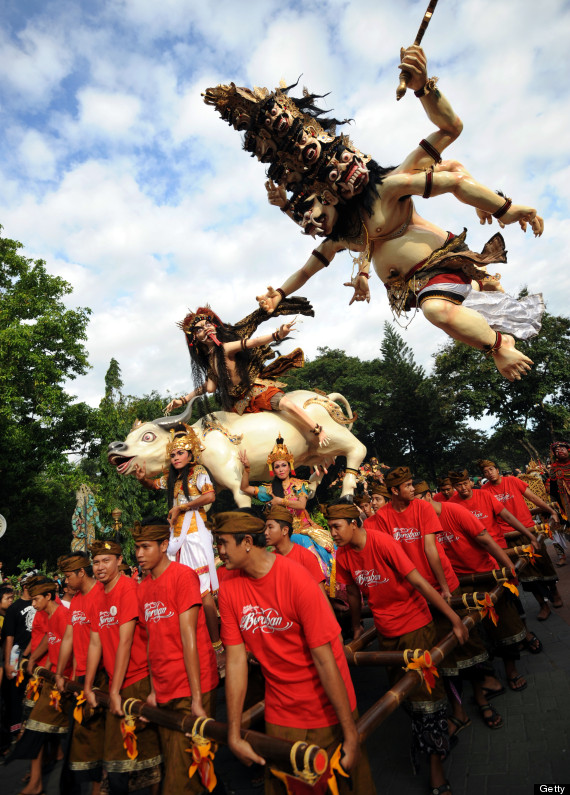
    Exactly one day before Nyepi, all villages in Bali hold a large exorcism ceremony at the main village cross road, the meeting place of demons. They usually make Ogoh-ogoh (the fantastic monsters or evil spirits or the Butha Kala made of bamboo) for carnival purposes. The Ogoh-ogoh monsters symbolize the evil spirits surrounding our environment which have to be got rid of from our lives . The carnivals themselves are held all over Bali following sunset. Bleganjur, a Balinese gamelan music accompanies the procession. Some are giants taken from classical Balinese lore. All have fangs, bulging eyes and scary hair and are illuminated by torches.The procession is usually organised by the Seka Teruna, the youth organisation of Banjar. When Ogoh-ogoh is being played by the Seka Teruna, everyone enjoys the carnival. In order to make a harmonic relation between human being and God, human and human, and human and their environments, Tawur Kesanga is performed in every level of society, from the people's house.                                                                                                                                                                             In the evening, the Hindus celebrating Ngerupuk, start making noises and light burning torches and set fire to the Ogoh-ogoh in order to get the Bhuta Kala, evil spirits, out of our lives.
  • .Nyepi
    On Nyepi day itself, every street is quiet - there are nobody doing their normal daily activities. There is usually Pecalangs (traditional Balinese security man) who controls and checks for street security. Pecalang wear a black uniform and a Udeng or Destar (a Balinese traditional "hat" that is usually used in ceremony). The Pecalangs main task is not only to control the security of the street but also to stop any activities that disturb Nyepi. No traffic is allowed, not only cars but also people, who have to stay in their own houses. Light is kept to a minimum or not at all, the radio or TV is turned down and, of course, no one works. Even love making, this ultimate activity of all leisure times, is not supposed to take place, nor even attempted. The whole day is simply filled with the barking of a few dogs, the shrill of insect and is a simple long quiet day in the calendar of this otherwise hectic island. On Nyepi the world expected to be clean and everything starts anew, with Man showing his symbolic control over himself and the "force" of the World, hence the mandatory religious control.                                          Hasil gambar untuk nyepi  
  • Ngembak Geni (the day after Nyepi)           
    Ngembak is the day when Catur Berata Penyepian is over and Hindus societies usually visit to forgive each other and doing the Dharma Canthi. Dharma Canthi are activities of reading Sloka, Kekidung, Kekawin, etc.(ancient scripts containing songs and lyrics).          
From the religious and philosophy point of view, Nyepi is meant to be a day of self introspection to decide on values, eg humanity, love, patience, kindness, etc., that should kept forever. Balinese Hindus have many kind of celebrations (some sacred days) but Nyepi is, perhaps the most important of the island's religious days and the prohibitions are taken seriously, particularly in villages outside of Bali's southern tourist belt. Hotels are exempt from Nyepi's rigorous practices but streets outside will be closed to both pedestrians and vehicles (except for airport shuttles or emergency vehicles) and village wardens (Pecalang) will be posted to keep people off the beach. So wherever you happen to be staying on Nyepi Day in Bali, this will be a good day to spend indoors. Indeed Nyepi day has made Bali a unique island.

Wednesday, 18 March 2015

Monkey Forest

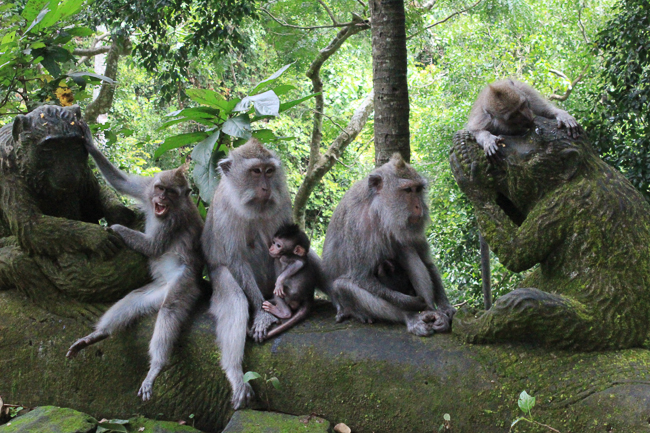
This cool and dense swathe of jungle, officially called Mandala Wisata Wanara Wana, houses three holy temples. The sanctuary is inhabited by a band of grey-haired and greedy long-tailed Balinese macaques who are nothing like the innocent looking doe-eyed monkeys on the brochures. Nestled in the forest, the interesting Pura Dalem Agung has a real Indiana Jones feel to it with the entrance to the inner temple featuring Rangda figures devouring children.
 
You can enter through one of the three gates: the main one at the southern end of Monkey Forest Rd; 100m further east, near the car park; or from the southern side, on the lane from Nyuhkuning. The forest has recently benefitted from an infusion of money. Useful brochures about the forest, macaques and temples are available. Note that the monkeys keep an eagle eye on passing tourists in hope of handouts (or an opportunity to help themselves). Don’t feed these creatures.

Tour information : kayu_urip@yahoo.com

Friday, 13 March 2015

Ubud Palace/Puri Saren

Ubud Palace/Puri Saren

Hasil gambar untuk ubud palace  Puri Saren Ubud (Ubud Palace) is an Ubud Kingdom Palace with beautiful Balinese traditional houses as a residence of Ubud King. It is set in the center of Ubud Bali with traditional art market just in front of it and it is found by Ida Tjokorda Putu Kandel who has commanded from year 1800 - 1823. This palace is an artistic cultural life center, while the traditional market is the symbol of local economics resident. The existence of Puri Saren as a palace is equipped by a Wantilan/auditorium that is a large building of meeting room and a banyan tree as shelter place at the daytime. The traditional market is the place of society economics and its existence is always border on palace as artistic cultural life center. It means that the both pole meeting is describing the dynamics of society and kingdom life.

Places to Visit in Ubud

Puri Saren, Ubud palaceThe tourists who purchase the tour package to Ubud will visit this place and they will feel not complete if they are not invited to visit the Puri Saren (Ubud Palace) and traditional market, because both of these tourist destinations are the soul and identity of Ubud Village itself. The palace is very beautiful with artistically traditional building and contains the high esthetics value. It is situated in the good temperature which can give the ruthless and freshness for every visitor. Some world class painters from Europe have lived in Ubud like Rudolf Bonnet, Walter Spies, Arie Smith, Antonio Blanko, Hans Snell and others. These entire world class painters through its painting masterpiece have indirectly followed to promote Bali Tourism because theme or their painting objects are about the culture and nature of Bali. Ida Tjokorda Agung Sukawati has exploited his palace as lodge place for his entire respectable guest.

Ubud Palace in Growth

In the year 1928, the Tjampuhan Hotel is founded for all empire's guest and on 1934, this hotel is opened as a lodge for empire's guest and also used as a center place of Pita Maha Organization Activities. Tjampuhan Hotel is an eldest hotel in Ubud with the traditional style. In growth hereinafter, Ubud as a tourism destination is one of tourist area in Gianyar Regency own separate specification. 
More info & Tour : kayu_urip@yahoo.com
facebook : Bali Kompra Tour

Kentalnya darah Seni Ubud

Ketika berbicara pusat seni dan budaya di Pulau Bali sekaligus suasana yang nyaman maka semua sepakat Anda akan diarahkan ke objek wisata favorit ini. Ubud terletak di Kabupaten Gianyar Bali, tempat ini menawarkan berbagai keindahan alam, pentas seni dan budaya, serta hasil kerajinan masyarakat Bali yang eksotis.
Dengan lingkungan yang masih alami, daerah ini merupakan daerah sumber inspirasi bagi para seniman, termasuk seniman luar negeri, terutama seniman Eropa. Berada di antara sawah, hutan, dan jurang-jurang gunung yang membuat alamnya sangat indah. Selain itu Ubud dikenal sebagai tempat dimana seni dan budaya Bali terjaga dengan baik. Denyut nadi kehidupan masyarakat Ubud tidak bisa dilepaskan dari kesenian. Di sini terdapat galeri-galeri seni hingga arena pertunjukan musik dan tari digelar setiap malamnya secara bergantian di berbagai penjuru desa.
Ubud adalah tempat yang sempurna jika Anda tertarik untuk belajar berbagai seni Bali seperti melukis, mengukir, atau menari. Ya, karena di sini banyak terdapat sanggar seni. Bahkan bila tidak pun maka di Ubud sudah cukup memuaskan Anda untuk sekedar menikmati suasana Bali tradisional lalu membawa pulang oleh-oleh seni kreasi tangan yang berkualitas tinggi.
Ubud adalah tempat yang tepat untuk Anda mencari kedamaian dan ketenangan. Ubud menawarkan tempat peristirahatan dari rutinitas kota yang menjemukan. Di Ubud Anda dapat memanjakan tubuh dan pikiran, karena di sini terdapat restoran dan spa berkualitas yang akan membuat Anda rileks dan puas. Berjalan-jalanlah melewati sawah yang menghijau, melihat karya seni dan budaya yang eksotis, bercengkrama dengan penduduknya yang ramah, dan melihat prosesi adat dimana wanita Bali berjalan menuju pura dengan anggun sambil menyeimbangkan tumpukan sesajen buah-buahan di kepalanya. Itu hanyalah sepenggal kesan mendalam yang dapat ditangkap saat mengunjungi tempat yang indah ini.
Cara terbaik untuk menyelami tradisi dan budaya Bali adalah melebur dengan penduduk setempat dan melihat keseharian mereka. Di Ubud, Anda dapat mengunjungi pura dan desa yang relatif tidak banyak berubah selama bertahun-tahun. Sebuah kenangan akan suasana dari masa Hindu di Jawa dahulu yang sulit akan Anda temukan lagi sekarang ini.

Kawasan Ubud yang mempesona semakin lengkap dengan sejarah, seni, dan budayanya yang kaya. Temukan juga jejak kerajaan Bali, kesenian, dan kerajinan tangannya yang indah dan unik. Di Ubud banyak terdapat galeri-galeri seni, lukisan, dan pahatannya yang luar biasa menunggu apresiasi dan decak kagum Anda. Belilah salah satunya karena itu mungkin akan sangat sempurna untuk mempercantik ruang tamu atau ruang keluarga di rumah Anda.
Ubud dikenal sebagai daerah yang tenang dengan pemandangan yang asri. Menawarkan kepada Anda suasana alami untuk menenangkan diri. Pemandangan sawahnya menawan, suasananya sejuk, dan penduduknya ramah, sebuah lingkungan yang akan membuat jalan-jalan pagi dan sore Anda menyenangkan.
Telah banyak orang datang ke Ubud mulanya hanya untuk satu atau dua hari tetapi kemudian mereka tinggal lebih lama, larut dalam budaya dan keindahannya yang mengagumkan. Ubud adalah tempat dimana Elizabeth Gilbert menemukan kedamaian dan cintanya seperti ditulis dalam buku best seller miliknya itu, “Eat, Pray, Love”. Buku tersebut akhirnya difilmkan, dibintangi aktris ternama Julia Robert dan aktris senior Indonesia Christin Hakim.
Datanglah ke Ubud, lalu dapatkan sebuah pengalaman wisata yang tak terlupakan. Setelah Anda pulang dari Ubud maka yang tersisa hanyalah kedamaian, rasa persahabatan, dan keindahan alamnya yang seolah tersenyum mengundang Anda untuk kembali lagi ke Pulau Dewata yang memesona.

More info & Tour : kayu_urip@yahoo.com

Tuesday, 10 March 2015

Griya Santrian

Griya Santrian is delighted to announce that it has launched a brand new wing just in time for the summer holiday season. Accommodation at the resort is now a combination of traditional Balinese architecture and modern rooms to satisfy the needs of satisfy the needs of discerning travellers. This unique mix of styles enables guests to experience the best of both worlds.
    Hasil gambar untuk griya santrian
The new wing is located in a peaceful corner of the resort that is close to the lobby in a setting surrounded by a lush garden of refreshing greenery. It incorporates an additional 34 Deluxe Rooms in a design that celebrates the essence of Balinese artistry infused with contemporary elegance. 
The wing features a combination of 2 and 3 storey clusters with an elevator to ensure easy access for guests with mobility issues. There is also an infinity-edge pool and relaxation pavilion. This provides a stylish alternative to unwind and sunbathe in a more secluded environment away from the beach. 
Deluxe Rooms at Griya Santrian embody the spirit of tropical living where personalized hospitality is second to none. Each spaciously appointed room comes complete with its own terrace and a cushioned daybed. Spa-inspired en-suite bathrooms promise lavish bathing rituals with a generous sized rain shower cubicle. Luxurious touches and essential lifestyle amenities include a 42" LED television to enhance overall quality of stay.